Wednesday, April 23, 2014

Oriental or Orientale Dance?

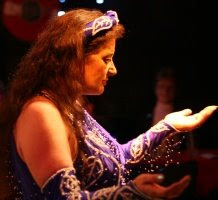
Lale Sayoko
 - a real Oriental Dancer
The term “oriental” comes from the French – Danse Orientale – which means the same as raqs sharqi in Arabic – “dance of the east”. I’m not sure which term came first (by 1926 raqs sharqi was being used in Egypt) but either way it is east of Paris – not Cairo.
So, here’s the first difficulty. If you say “oriental dance” to the General Public (especially in New Zealand) most will think that it is something from the far east – China or Japan. By using a word they are familiar with in a different context you are confusing not enlightening them. Those with a little more knowledge use it as evidence that “belly dancing” came from India – after all is called “oriental dance”!
The problem is it isn’t a straight translation. It has technical context - like plié or jeté. Not good examples as they have simple translations. More like pas de boureé - it does not just mean step of a traditional French dance - it means a specific way of moving the feet.
This is once reason I prefer the French spelling and (an attempt at) French pronunciation – “Orientale”. This clearly signals I am not talking about “oriental” in the normal English sense. I am using a technical term to describe a type of dance. The other reason is I have been told, by a number of Egyptian dancers, is that this is the term they use – rather than raqs sharqi or belly dance.
When used in this context, Orientale is a specific style of dance (from professional entertainers in Egypt/Lebanon etc). It does not include social dance - unless they are trying to dance like professionals. It does not include beledi. It does not include shaabi - or in most cases dancing to pop music. It does not include any folkloric dance. All of these are part of most belly dancer's repertoire and are not Orientale.
There is also a tighter meaning , which refers specifically to dancing to the complex, layered, orchestrated music such as was popular in films and shows in Egypt’s Golden Age and Classical Age.
However, it is not a synonym for the American Seven (or Five) Part Routine. Although many people would call this “Orientale” under the looser definition. An Egyptian Orientale for instance is not put together as one song after the other moving from veil to a drum solo. Some may include many styles – but the “parts” may vary from a few bars to full songs – and there will be repeats and changes. However, some may be one long piece all in a similar style.
But what it certainly does not mean is anything that is not Tribal! There are many other styles of belly dance that are valid – but not Orientale. For stage presentation (Urban) Beledi is the most obvious. None of the folkloric styles are Orientale – just the opposite.
I think part of the problem is people want an umbrella term – that isn’t “belly dance”. Maybe we just have to live without – or adopt something completely different such as the Hungarians did when they finally adopted tanc as a noun that would cover a range of different dance styles.

Tuesday, July 16, 2013

Giving a Soloist Her Due

Recently someone asked me whether a dancer may have been insulted or upset when her group started doing a tribal improvisation behind her performance at a hafla. Not being there, I couldn’t really say whether she left because of them or whether she had an urgent phone call to make. However, in her place I think I would have been at best annoyed. Here are some of the reasons that I can think of:  
  • If you are going to do this, first ask the dancer if she is okay that you do this.
  • A soloist is performing to an audience – asking her to share its attention with a group moving behind her is at best rude.
  • Worse, this dancer was doing an orientale piece with a lot of emotional connection and display of technique which deserved the audience’s full attention.
  • The (beginner) students had lots of friends and family in the audience which made it all the worse as they cheered on their mates.
  • At the best of times Orientale and Tribal don’t really mix.
  • Similarly, it is tricky to mix professional dancers and students. It can work with a teacher and her students if she adjusts her technique to fit with them – some times.
So, no, I have no idea if the dancer was upset – or if she was, if any of my reasons overlapped with hers. But I would strongly suggest, even in an informal hafla situation, you don’t show your joy of the dance by getting up uninvited and boogieing along behind a performer.


Thursday, March 28, 2013

Becoming Fifi

Me as Fifi
It’s not often you get a chance to become Fifi Abdou – but that was what was handed to me by the organizer of a local hafla when Zumarrad suggested performers take the challenge of dancing in the style of a well known dancer.

Foolishly I thought it would be easy. Fifi has been one of my dance role models for many years due to her relaxed beledi styling and her attitude. I can do beledi and I have lots of attitude!

I started by gathering several hours of video I have of her performing. Then I watched them – and rewatched them. I danced along with them - mirroring her posture and moves. I sat and analysed – taking notes about characteristic moves and transitions.

After a month or so, I had found one part of her style that I thought I could do justice to – late career beledi. Now to select music and costume. I selected music that I could (in theory) maintain the loose beledi shimmy throughout that is one of her trademarks. I had already had a white, silk gallebaya from Aida Nour and a trip to a costume jewellery shop got me chunky, shiny anklets and bracelets. Red nail polish – of course!

Next I made a short list of characteristic moves that I would include. I had already noticed that Fifi was able to play with a single move for minutes at a time. The question was – could I? Did I have that much confidence? I was willing to try – I intended to improvise in her style hitting the three or four moves I had noted (loose, continuous shimmy, flat footed hip drop-swivel, bust shimmy and chest heave) – with typical manipulations.

The hardest aspect, though, seemed to be her arms and hands. Sorry, but they really are not attractive. The often static beledi second with splayed hands (palms forward) is a look I’m forever trying to train out of my students. My own dance also tends to use a lot of soft shoulder rolls, arm undulations and weight shifts with ribs. All scratched.

Time to go solo – and I froze. Instead of dancing I was thinking – “is this typical?”, “where can I fit that in?”, “mustn’t do that!”. The flow had gone. The connection with the music became mechanical. It was almost like learning to dance all over again. I briefly toyed with the idea of creating a choreography to smooth out the rough edges but in the end hung in there. Practice. That’s what it takes.

When I night finally arrived, I was glad I’d stuck with improvisation. That gave me the chance to interact with the audience in a way no choreography would have allowed. I mean, I’m sure if there had been cell phones in Fifi’s day she would have stopped and checked members of the audience’s text messages just like I did. Oh, and yes I did dance too. I suspect a little more busily that Fifi herself would have but not at all like how I would have performed as myself.

The whole experience was very challenging – but very valuable

Wednesday, February 20, 2013

The New Normal and Dance Classes


A recent offer from an overseas teacher to take workshops in Christchurch brought the reality of the new normal to my consciousness. Apart from the difficulties of arranging a workshop for someone unknown in the community at short notice, I realized I wouldn’t be able to do it even if Fifi gave me two weeks notice.


Over two years (and 13 218 earthquakes) on, here’s the reality of living in Christchurch if you are interested in dance.

Venues

Many venues are damaged. Many fell down or have been demolished. Many others are unable to be legally used (Red or Yellow Stickered). Space that is left is at a premium (any space – forget having a dance studio with mirrors). With enough warning you might be able to get a class to move so you could use the space for an extended time for a workshop. But not every one is willing to give up their own class – or multiple hourly hires. So if you can find something it won’t be cheap.

Something you organized last week (let alone last month) may no longer be available. When they decide to repair you get very short notice. I have heard with private homes of only 24 hours notice being given - although a few days is more common. Buildings are also being closed at very short notice. A few weeks after the February earthquake, I was in the middle of teaching a class when the hall we were in was deemed unsafe and we had to leave. But even within the last month or so, our local shops were closed and the shopkeepers given less than 8 hours to vacate.

Roads

The roading infrastructure is being repaired. That’s great – and when it’s finished we’ll be able to get around like we used to but in the meantime …

Our local bridge has been closed one way for about five months – and it’ll be closed for at least another seven. The way out is at best rutted gravel. On some days you get to drive on the side that is just half a metre of semi compacted gravel with wheel eating potholes. The way in is an extra 3km and until last week was also rutted gravel – with the additional fun of threading through a road narrowed by cones as they try and fix something; from there a choice of a maze through a shifting set of streets – or chance the river road isn’t under water or closed for repairs.

Then you hit Estuary Road where the underground services are in the process of being repaired – ongoing for the last two years. Sometimes one direction or the other will be closed. There is a sink hole that keeps appearing that is about as long as my car and about half a metre deep.

When they finish our bridge they will start on the next one over. So then our bridge will be able to carry both 10,000 cars a day from South Brighton and will be joined by as imilar number from New Brighton. Yes, in theory the New Brighton people could go upstream (assuming they aren’t repairing that bridge). But the road around the river which is now below high tide level and sandbagged, still floods. This does not just mean getting brackish water sprayed under your car but also the regular flooding has destroyed the road service and it is heavily pot holed. Cover the potholes (some quite deep) with water and it really starts to get exciting.

But all of that is known. I can plan an extra few minutes as I know I will have to detour to get home. What you cannot plan for is every other road. You never know when you set out somewhere whether or not the roads will be open. On two occasions I have been sent in circles in areas I was unfamiliar with trying to get back to where I wanted to go. Oh, and many landmarks – buildings and shopping centres have gone and are replaced by sections of rubble so often you have no idea where you are. (And no, GPS systems don’t help – they can actually make things worse trying to push you back into closed streets)

My students are reporting over 15 minute delays due to detours. Add congestion due to vehicles threading through fewer and narrower roads and you can add at least an additional 30 minutes to cross town.

The upshot is many people don’t take non-essential trips – such as going to dance classes, or won’t travel at night (easier to get lost in detours or hit unexpected potholes or flooding), or arrive with nerves shot and totally stressed.

Stress

Many of us are stressed. Still. Yes, I know – boring. Apart from the roads, there is the effect of continual aftershocks which some people cannot handle as well as others – adrenaline surge followed by crash over and over does nasty things to your body. Yes, the aftershocks are now infrequent and mostly light but for many the damage is done. (In the past week there were only 14 aftershocks – all small.)

A very small number of people are still living without services such as sewage. Many are over-crowded. (A two bedroom flat next to my parents’ was home to three families with children. Some were sleeping in the garage and some in an old horse float!)

Then there are a list of losses, including for some the death or serious injury of a close friend or relative; thousands have lost their homes; some have lost their whole neighbourhood; many have lost their jobs (and income); many are losing their schools, some are upset about the loss of the architectural heritage which defined the Christchurchness of home.. Add to that a swag of “things” smashed, damaged or irretrievable – sure some things can be replaced. But some have emotional significance and are mourned.

Adding insult to the loss of income or equity there are increased costs as insurance premiums skyrocket and vehicle repairs increase with the crappy roads.

Then there are a range of physiological effects. Not only feels of loss, but unease, lack of trust, uncertainty, fear, anxiety. All made worse as people struggle to sort out insurance and get repairs done (if they still have a house) and live day to day.


No wonder then numbers are right down. By offering extra classes outside my own studio (being in the Eastern suburbs is a distinct disadvantage with most of the written off houses and the worst roads), and being willing to hold classes even when only one person can make it, I’ve held my losses to only half my pre-earthquake income. But I don’t have extra energy to organize workshops that won’t be filled in venues that I cannot get hold of.

Thursday, December 6, 2012

Characteristic of Belly Dance?

 Recently I heard an experience belly dance teacher describe belly dance as “characterized by sharp, isolated locks as well as sultry “snakelike” movements.”

Really? Characterized by? I went out and re-viewed some of the videos I have of top belly dancers that I admire – Fifi Abdou, Naima Akef, Aida Nour. Not a “sharp, isolated lock” to be seen. Not much snakes either. So, maybe she meant American belly dancers – Cassandra Shore? Nope. Morocco? Nope. Shareen el Safy? Nope.

So what did I see as characteristic among these dancers? Physical control and grace certainly – but that applies to any dance form. Isolation and control – but in a quite gentle and deceivingly “natural” manner. Shimmies and layering – often. Use of pelvic initiated movement. Use of curves and circles.

But to a certain extent all this can be seen in other dance forms. Jazz is often isolated. Shimmies can be found in island dance; hip movement in South American dance; Martha Graham and Gaga technique use pelvic initiation; Hula uses hip circles.

The two stand outs are the music used and how it is interpreted. A characteristic of belly dance is the use of (a subset of) Middle Eastern and North African music. If you do Highland dance you use Scottish music. If you do Bharatanatyam you use the appropriate music from the south of India. If you do hula you use Hawaiian. Same with belly dance.
Interpreting the music is the other side. You can take an appropriate piece of music and use the belly dance vocabulary and still come up with something that isn’t entirely “belly dance”. One aspect is that belly dancers make the music visible (but that doesn’t mean hitting every accent). This is different from a number of other dance forms – Contemporary is a case in point where our teacher complains if we lock into the music!

But there is more. Easy to spot when it doesn’t work. Hard to describe. To get a feel for how it should look watch lots of (good) native dancers. Watch their performances over and over. Try and follow along to see how they switch between rhythm, melody and lyrics. Because at its roots belly dance is a Middle Eastern dance form. You can adapt and change it – but if it drifts too far from its roots it becomes something else. Not necessarily bad dance or worthless dance – but different dance.

Monday, November 12, 2012

How to Shimmy

So now, we have a definition of a shimmy, the next question is how to do it. And, no, the answer is more than “move very fast”. There are a number of ways that you can move. Let’s take the two most common shimmies the “shoulder shimmy” and the “hip shimmy” – that isn’t two shimmies. It is at least seven!

Shoulder Shimmies

There are (at least) two moves known as a “shoulder shimmy”. One moves the shoulders horizontally and one twists the torso.

The horizontal shoulder shimmy is very isolated and used only in Orientale – it isn’t used in folk (unless you want to layer it with a shoulder roll). In its pure form you pull the shoulder back and push it forward without twisting the torso – or lifting or rotating the shoulder.

The more common form may include some horizontal shoulder movement but is mainly driven by twisting the torso. But it is more complex than that. You can generate the twist in different parts of your torso to give a different flavour.

Hip Shimmies

My own default hip shimmy is driven by the concentric contraction of lateral flexors - particularly the quadratus lumborum with the internal and external obliques (I had to analyse it for a ‘varsity paper but needed the help of a sports physio!). In layman's language, I use my waist muscles to drive the hips up and down - but the knees bend to accommodate the movement. (They have to.)

Most people learn to shimmy by initially bending and straightening alternate legs. This means the hips go up and down but the lateral flexors just go along for the ride. (This is sometimes referred to as a "knee shimmy")

Another common (older style?) shimmy involves twisting the hips back and forward. Again you can drive this with the obliques or the legs. (This is sometimes called a "Folk Shimmy")

The Modern Egyptian shimmy is really a refined version of this driven by the legs (the knees are not "straight" as in locked - but straighter to look good under a slim line skirt). You slightly flex one leg then straighten it using your quads. This drives the hip back rather than up.

A recent invention is the Salimpour glute driven shimmy. This looks to me as if it is almost getting away from a relaxed shimmy and moving more into a vibration. However, many people do use it.

As with the shoulder shimmy, people often don't do a "pure" version of a shimmy but mix and match - sometimes always but sometimes for a particular effect or layer. And few people know or care what muscles are doing what. What is important is how it looks; whether it fits the music.

Then there is a whole family of “three-quarter shimmies” where your hips move only three quarters of the time. How the hips move and which leg carries the weight make this a whole article in itself (maybe later).

Practice

No matter which shimmy you use, it needs practice to be smooth and controlled. It is important that the underlying technique is correct. So, start slow and build up the speed. If you lose it back off the speed – then bring it back up. Remember it should be in time with the music. Ideally it should be relaxed – even when small and fast.

Once you have the speed – go for endurance. Can you shimmy for a whole track? What about something longer?

Then you “just” add weight shifts and layers. Try shimmying on one leg. Which shimmies work best? How does shifting your weight change the feel of the shimmy? What about walking with a shimmy? Figure eights? Oriental circles? As you approach some layers you may have to go back to first principles and work out exactly why you lose your shimmy at the back of your circle or whatever.

It takes time. 10 000 repetitions to bed in a new movement pattern - but it has to be 10 000 correct repetitions. Go for it!

Sunday, October 28, 2012

Shimmies Defined

Questions about what are shimmies, how they are generated and what are they called frequently comes up in various belly dance fora. So, here is a quick summary of the first question (I’ll leave the others for another blog).
Although the shimmy is a defining movement in belly dance, not everyone agrees what it is. For me, a shimmy is a repeated, smooth, relaxed, driven movement in time with the music – usually double time.
There are some related moves – which are fast shaking movements – but are not shimmies. For instance:
  • A vibration - which is tense – not relaxed
  • A freeze - which generated by muscle fatigue/tension rather than driven
  • A reverb(eration) – a driven movement followed by a loose, gravity generated shake (in my classes the Denise Walk is a classic example)
  • A mess – just jiggling around – not timed often tight and lumpy with no connection to the music at all
Although terminology does vary between teachers but I find this breakdown useful – and many experience belly dance teachers would agree with most of this.

One bone of contention is the three-quarter shimmy. In this, the shake only happens three quarters of the time – and there is a short rest. So instead of a chukka chukka – it becomes chukka chuck. For me, if the movement part is smooth, relaxed and driven I would class it as a special type of shimmy. However, there are teachers who have banished it into Not-Shimmy-Land.

So what can be shimmied? Actually anything – although most common in belly dance are the hips/pelvis, shoulders or torso. The whole body can get involved with the movement travelling from the hips the te belly and up to the bust. But I have also seen hands (especially in Khaleegi), eyebrows (Persian) and nostrils! (Greek).

But whatever you move it should match the music in speed and texture. Don’t shimmy just because you can; shimmy because the music asks it of you.