Friday, July 16, 2010

Value of Workshops

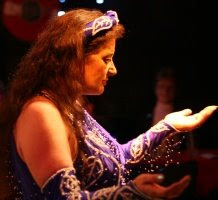
Aida Nour.
I have just recently returned from the Winter Warm Up in Brisbane . This year’s guest teacher was Aida Nour. It was well worth the time and money – as it has been for each of the last 14 years I have attended.

Why I Attend Workshops

Every year I learn something new – which makes me smile at those who have learnt it all in a year or so. Am I just thick or did they really have better and more experienced teachers than Aida Nour, Denise Enan, Dr Mo Geddawi, Yousry Sharif, Mohamed Kazafy or Lubna Emam? I suspect it is a case of “unknown unknowns”. Seems many belly dance teachers today know only the surface of the dance. They don’t know its history, any folkloric styles, and have limited understanding of Arabic (or Turkish) music and how to interpret it. No surprise than that they soon run out of things to teach. Worse, when one of their students decides to start teaching …

I go partly as it is a chance to learn from the source of the dance unmediated by western bias. All the Winter Warm Up teachers (apart from Bobby Farrah) have been Egyptian born with a long history in professional belly dance. They can dance Orientale. They also know Egyptian folk styles – the movement vocabulary, the music and the costuming.

But also the format means you get a chance at depth you can never get with one or two short workshops. Over four (or even better eight) days you can begin to see patterns in the way a dancer works. Something you couldn’t get on day one, snaps into focus on the third day, for example. Some years we have worked on the same piece for two days. Ten hours concentrated work on a dance certainly helps cement it into your muscle memory.

There is also the sense of community. Once a year you get to met in person with those who share a passion for Egyptian belly dance. A rare breed. It’s great to be surrounded by people who can discuss the evolution of Egyptian dance or who understand that milaya lef was created by Mahmoud Reda and can compare different interpretations.

Finally, in New Zealand I have a very limited pool of teachers who I can gain much from. Either they are involved in styles I have no interest in or their own knowledge is less than my own. Attending workshops gives me something to stretch me and something I can work on for a few months.

Why Do So Few Attend (Challenging) Workshops?

So why don’t more teachers (especially) attend more challenging workshops? Access is an issue. The Winter Warm Up is in Australia which means a passport, time off work and family, money for workshops, accommodation and travel. There are few “grown-up” workshops for belly dance in New Zealand (with would be more accessible). Yes, we have had Cassandra’s Oasis Dance Camp – but only twice. Other international teachers do make it to New Zealand but invariably they tone their material down to reach as wide a catchment as possible. The problem would be that we are a small country and are unable to pull the numbers needed for a solid, extending workshop.

But wait a minute! We have thousands of belly dancers in New Zealand. I, alone, can think of 80 teachers here. True some of them would only be interested in Tribal workshops – but that is only a small proportion. If half of the teachers were willing to attend a workshop there would be the numbers to bring someone with a lot of experience to New Zealand. But you have to ask how many of those teachers would be capable of handling 4 or 5 hour days? I still remember my surprise at the Oasis Dance Camp when at least two teachers were buggered after about an hour’s dancing.

One must consider whether a desire not to be “shown up” is part of the reason some people don’t attend workshops. Personally, I rarely see anyone else in a workshop – I’m too busy working on my own stuff. With Aida I was surprised when she split the class in half so each could dance for the other and I discovered dancers I deeply admired had problems too. One had difficulty remembering the choreography. Another had a lousy shoulder shimmy. A third couldn’t modify her style to match the style we were meant to be performing. I don’t see them as any less a dancer, but it reinforces that we all have things we need to work on.

Another possible reason is that some dancers think they know all there is to know. They don’t attend workshops because they don’t think they need to. In some cases they may have a deeply flawed concept of what they do and do not know. For others they may have attended a workshop that was badly labelled – for instance a “professional workshop for advanced dancers” taught by someone with poor dance skills and no teaching ability. Correctly judging they could do better, they then avoid workshops in the future as a waste of time.

Meet the Challenge

To all of you, I say, you have to keep pushing the limits. It is extremely rare to improve without some outside stimulus. Talk to other dancers who have similar interests and find out what is worth going to. If you want to get out of the rut, start saving money and leave so you can do at least one challenging workshop every year or two.

Wednesday, June 16, 2010

Bouncing Breasts as a Turn Off


All mammals have them. In many adult human females they are quite noticeable. So why are they ignored when it comes to physical exercise? Yes, yes, I know about sports bras – but honestly they are of limited use. In the short time I played soccer only binding with crepe bandages was really effective.

Two incidents have had me thinking about breasts again. One was a presentation I attended on introducing exercise to the community. One (male) presenter was extolling the virtues of jogging (as opposed to running or fast walking which causes a lot of leverage on the joints). Jogging was great. The feet stayed under the bulk of the body weight. The heart rate was raised because the body is lifted and moved slightly forward very rapidly.

Mmm, I thought, bouncing up and down for 30 minutes – do they really think this is going to take off with the under-exercised and over-weight in the community. Especially women? Even with a good bra, as an E-cup, I avoid anything that is going to lift and drop my torso for even a few minutes – let alone thirty.

I waited for someone to object. The only query was on the effect of jogging on the joints which let to a complex discussion on how fast walking can be more detrimental. Oddly enough most of the audience was female – but of the light lean variety. I am still unsure if the silence was due to a complete obliviousness to the issue or whether no-one wanted to mention “breasts”. However, as two of the other presentations by women were also the jump round turn around variety I suspect many in the industry have never lived with the reality of female breasts and vigorous exercise.

So maybe belly dance is the answer. If you avoid some folk styles such as sa`iidi and debke there isn’t a lot joggling up and down. Yet breast blindness appeared again recently on an internet forum.

The subject was shoulder shimmies. There are many ways to create a shoulder shimmy but the two main mechanisms is to articulate the shoulders back and forward very quickly or to twist the torso as a unit. (You can do a mix and you can also change how high the torso twists.) Personally I refer to the former as “shoulder shimmies” and the latter as “torso or bust shimmies”. The latter is more common in folk styles. The former is most often seen in Orientale.

The issue was many larger busted women found the bust shimmy uncomfortable, ugly, and made them feel self conscious. However a number of the other dancers and even teachers could not understand this. There was discussion on using well constructed bras and improving isolation – both valid comments – but few would be willing to change the technique to an (articulated) shoulder shimmy.

My point? When leading exercise for a group that includes women who are not (for what ever reason) washboard ribbed, consider the effect of the movement on the women’s body. Making your clients uncomfortable and unhappy is not going to encourage them to come back.

Thursday, February 25, 2010

Challenging Yourself

In belly dance there is so much to learn - even within a single style. It is a chance of lifetime learning. The first challenge most people face is actually taming their body. Learning that hip figure eight that does what you want it to do - staying horizontal or vertical or doing a combination of both and keeping it smooth. Getting a shoulder shimmy that moves only the bits you want to shake.

What might surprise many beginners is that "getting you body under control" doesn't really stop. You just add more difficult moves to your repertoire. (Not that belly dance is about having to master more and more difficult moves - but you don't learn it all when you can execute a flawless set of isolations on each part of the body).

For many people the next step is learning movement combinations, layering and transitions. Some then start collecting choreographies. Some then challenge themselves with improvisation. Both are valid. What both are working towards is learning to interpret the music - within the belly dance genre.

This step requires some outside assistance. Although a dedicated and talented person might be able to learn the moves, it is much harder to learn to belly dance. For this you need a teacher - or even better a number of teachers. Some may be people you attend class with. Some may only drop in to take a workshop. Some you might learn from by watching their performances. Over a period of years by watching good examples of the dance and being corrected by knowledgeable teachers you extend your ability to be able to be a good belly dancer yourself.

A student of belly dance (and by that I also include the best teachers) also needs to understand the different styles within the dance. They don't need to be able to do them all well but they should be able to recognize obvious examples of (say) modern Egyptian style, Lebanese style, old style Turkish, AmCab etc. They should also have an idea of a couple of major folkloric styles from the area of interest - Egyptian folk for Egyptian dancer, Turkish or Rom folk for Turkish dancers etc.

Another aspect of the dance is a range of props. A basic set would include veil, zils and cane but there are many others – again depending on the style(s) you are interested in - sword for AmCab and Tribal, shamadan for Egyptian, spoons for Turkish. A belly dancer needs to know not only how to use them but when to use them. What music works. What movements go with them.

Then there are cultural factors. A dancer needs to know about what his or her music means. Not only what the lyrics say (and many instrumentals also have lyrics) but what it actually means and also what it means to the audience. For instance some very upbeat songs can be about loss. And some songs are metaphors – for example there is a song which appears to be about a man’s mother but is actually a political song about Egypt. For Egyptians songs by Oum Kalthoum have a particular significance and need to be treated with sensitivity.

So, some understanding of the language (whether Arabic, Turkish or Farsi) is useful. But an understanding of the people’s culture and history is also important.

One problem with self taught dancers – or those that do not have a good teacher – is that you often cannot know what you do not know. Experienced belly dancers are forever stumbling across people saying they have learnt it all (after a year, two months or whatever) so have had to branch out into fusion or burlesque or whatever. They shudder – but often it isn’t the dancer’s fault. They often truly don’t know they are missing 90% of belly dance.

So, if you are feeling a little too smug. Look around and find a new challenge within the dance. After 19 years I’m still learning new stuff – and I really only have a deep knowledge of Egyptian and generic belly dance.

Sunday, January 10, 2010

Belly Dance Hen's Nights

After a particularly busy lot of Hens Nights, a friend commented how hard it must be. I pointed out belly dancing for three hours, while unusual for me is well below a full day at a workshop - and at a much lower technical level. But that wasn’t it. Rather, it was turning up at a stranger’s house and offering to belly dance for them. “You’re so shy. What if they think ‘Belly Dance – how silly. I’m not doing that!’”

Well, first up I’m not “shy”. True, I’m an introvert – which means interacting with groups of people drains rather than invigorates me – and I don’t do small talk. But give me a role or a task and I have no problem fronting up to any number of people – dancing, teaching, lecturing – even giving directions on the street.

But not needing the approval of other people, like my extroverted friend, means I don’t feel personally hurt if people don’t warm 100% to me and my interests. Yes, some times a few individuals at a Hens Night are too cool to belly dance. And there are people who are too shy, too tired, too sore, too pregnant, or too drunk. But even they often get something out of the entertainment.

And at a Hens Night – that’s what I am - an Entertainer. I’m not there to show them how well I can dance. I’m not there to be admired. I’m there to help people celebrate their friend or relative; I’m there to let them have a laugh, take some silly photos – and maybe, just maybe, pick up a few belly dance moves.

Hey, if you think some of your friends might like this – and they live in Christchurch, New Zealand – feel free to contact me! http://www.bellyraqs.co.nz

Thursday, September 17, 2009

Belly Dance for Mental Agility

Much is often made of Belly Dance being great for improving physically flexibility – but what about mental flexibility? It can give you a great mental workout as well.

Take last weekend. It seemed like a simple gig supporting the local International community. We’d come along and dance for their get together. First hurdle – did I have any Middle Eastern students? Ideally recent immigrants or children of immigrants? No, but I’m the child of Hungarian parents and some students are Dutch. So our support was declined – until 10 days before the event was to be held when they decided that my site included enough multicultural material for me to pass.

Next hurdle - no real timetable. Okay, I can adjust. I’m not totally anal about my schedule. But that meant some students who had firm commitments elsewhere were unable to take part. So, for a 10 minute performance we were on site almost two hours being part of the community. Probably good for us.

Then there was the choice of material. Nothing to alienate conservative Muslims. I bit my tongue as I knew we could do nothing right if any really conservatives turned up. However, we have a wide repertoire of folkloric items. Cane is always popular. Then I realised the venue was small with a low ceiling and people would be sitting up close. No cane. I suspected my beledi would be incomprehensible to non-Egyptians. No beledi. With those that I had available at short notice it would be ghawazee as a solo. Maybe. Ditto haggala – and as a woman well past the first flush of youth I’d not be a sensible choice.


Okay – khaleegi. Our stage piece is for 10 – but I could only get 4 at short notice. A good thing too. Did I tell you the stage was small? 3 by 10 – over here we think in metres – and that would have been small for the tableau. But the organizer was old school – this was feet. So, restage and reassign parts – this is a group framework with solos and duets not a choreography with everyone doing the same thing. Add two hours of rehearsal leading up to the show.

So, one student thought this would be a good time to refurbish her costume and she unpicks it and starts reassembling it by hand. (For those of you who have never made a khaleegi thobe there is over 6m of fabric – that’s 4m of sleeve hem to restitch with slippery sequinned fabric.) Three hours before we are due at the venue she rings to say she’ll never get it back together in time. Thank goodness for spare khaleegi thobes. Only, I made the class set out of cheap material and now it has to be ironed – by me. (Along with putting on make up and running a last minute rehearsal)


Our second item? I took the easy route and did a stock belly dance piece – covering as much skin as possible with body stockings, sleeves and gauntlets. The audience –Korean, Japanese, Indian, Welsh, Australian and Somali - were not at all offended.

Overall, it went down very well. The students got a kick out of not only pulling off a nice piece of dance performance but also realizing that what they learn in class is not definitive. They are being given tools. They can adapt. Now they don’t just know this in the abstract – they know they can do it.

Saturday, July 18, 2009

So, Who’s Writing on the Net?

Recently a student discovered a YouTube clip of Ranya Renee doing a great beledi interpretation. This sparked an interest in beledi which she initially asked me about. I love beledi – it is my favourite style. But I was overwhelmed by catching up after a week at the Winter Warmup and had a huge pile of exams to mark. So my response was a little brief.

No problem. She then started an internet search and came up with a range of information. Some accurate, some suspect, some off. The email correspondence that followed really got me thinking. The first issue was simple – “why do you think your information is better than X or Y’s?” Because I got my information directly from Egyptian dance teachers who lived, worked, and studied in Egypt – such as Raqia Hassan, Yousry Sharif, Denise Enan, Dr Mo Geddawi, Aida Nour. Yasmina and Lubna Emam. Although one or two may have grasped the wrong end of the stick – I cannot believe all would have.

I should have anticipated the next question “then why can’t I find any information by them on the net?”. Maybe because they have better things to do with their time? Maybe because they are professional teachers and are not inclined to give away huge hunks of information for free? Maybe because neither English nor the internet is familiar to them? Maybe because they have difficulty in putting into words what they know through years of living in a culture? Maybe because when they hear a mawal they just know that this is how you move and this – but not that?

The third issue is a little harder. “Beledi” is a big concept. It has many levels of meaning. There are numerous associated music and dance styles which change over time, place and society. A good explanation isn’t a one liner. It isn’t even a whole webpage. It is a book. Yet, so often, it is expected that a couple of paragraphs will cover it. The ‘net encourages a very superficial gloss over of complex topics.

Finally there is the expectation that you can learn anything on the ‘net. You can learn a lot about some aspects of dance through the written word – if you share a common language – but not all. Video clips and DVDs also provide another tool. You can (usually) see what a dancer is doing. You can try and copy their movements. Many people have a gift of being able to do this. Many people struggle. Many people fail and don’t even realize it.

But belly dance is more than a string of movements. You need a context. You often need to ask someone about something which is obvious to them but a total mystery to you. “Why do so many beledi improvisations sound familiar?”, “Why do you wear that crochet thing on your face?”, “Who is this Fifi you keep talking about?” Often the student is unaware they even are missing something, which is where a live teacher comes in.

Experienced dancers and teachers know this. Less experienced dancers may take longer to learn – and in the meantime they are reading websites by those often with more confidence than knowledge. Then horror or horrors, they get their own website and repeat all the crap.

Saturday, July 11, 2009

What are the “Basics”?

When designing any course of study a teacher needs to consider what are the basics that their students need to master. The basics will form the foundation of future learning. A poor foundation will mean that a student could be unable to reach their full potential.
So, with belly dance what are those basics?

There are several areas that need to be addressed:
  • Physical skills
  • Dance skills
  • Performance skills
  • Cultural and historical context

Physical skills

A basic requirement for a dancer is co-ordination and control. Without this they are unable to use their body to express movement. Tied to this is automatic abdominal control to enable many of the standard moves to be performed safely. This is the automatic response of the body to protect the back and use the deep abdominal muscles.

In belly dance flexibility is a lesser requirement. Most belly dance does not require extreme range of motion. However, balanced flexibility is advantageous. This will allow a student to maintain good posture with minimal effort. Reasonable range of motion in the hips and lower back is also beneficial.

Unlike many other dance forms raw strength is not an issue. Apart from some folk styles there is little jumping required and no lifting. However, physical endurance is useful to enable a dancer to train over long periods and maintain good quality movement.

Only once the body is in a fit state can the teacher focus on “moves”. A belly dancer needs to be able to move parts of their body independently from each other. They need a basic vocabulary which includes moving the hips up and down and in circles and moving the shoulders and torso in typical movement patterns.

The initial – or basic moves – need to be physically safe for the new dancer. Moves such as mayas which are standard in many belly dancer’s vocabulary are not safe for many new dancers with insufficient abdominal control to perform them safely.

Dance skills

Building from moves, a dancer can learn combinations and travelling sequences. These need to be more than just exercises in movement but also be an expression of musicality. With a new dance style many students will need to be taught how to interpret the music by their teacher.
Many teachers include the ability to remember and perform choreography in their basics. Others do not. For some it is the ability to improvise to the music that is important.

Some teachers consider prop use (eg veils, zills, and cane) to be basic. Personally, I’d rather see a dancer secure in their body before adding an extra layer such as playing zills.

Performance skills

Although in the long term, stage presence, emotional communication, costuming and make-up are important in the dance, I would not count them in the initial basics.

Cultural and historical context

I would however include an introduction to belly dance’s cultural and historical context as “basic”. Why? Because without that the students might be learning dance – but they are not learning “belly dance”. A lack of context leads to poorly informed students believing anything with an undulation in it is belly dance. It leads to people who are unable to distinguish belly dance from hula. It helps many of the inaccurate myths bred. Shining a bright light on the background of the dance and distinguishing between belly dance and creative movement is an essential part of a belly dance teacher’s core job specification.

Teaching this while keeping the learning fun and extending the student’s dance ability is really what it is all about.